Sunday, 5 May 2019

Movements in music


Movements are divisions of larger pieces of music into sections, usually (but not always) marked by a pause in the performance. Works are that most often described as having movements are symphonies, concerti, sonatas and chamber pieces such as trios and quartets. However, it is also possible to use the term for the separate elements of suites, masses, sets of variations, and various kinds of program music. The divisions of operas and ballets are normally described as acts and scenes, thus reflecting their relationship with the theatre rather than the concert hall.

Independence

Movements are frequently seen as having a degree of independence from the work to which they belong. Classical music radio stations, such as the UK’s commercial station Classic FM, play separate movements more often than full symphonies, etc, and many listeners are often unaware of how they relate to the complete work. There are indeed some movements that are so famous in their own right that they have virtually left home – examples include Widor’s Toccata, which is actually the final movement of his Symphony for Organ No. 5, and the brilliant scherzo by Henry Litolff that is the 2nd movement of his Concerto Symphonique No. 4. In both cases, the vast majority of music listeners have not heard a single note, other than these movements, that was written by the composers in question.   

First movement sonata form

It is not easy to generalise, but the standard symphonic (etc) first movement follows what is known as sonata form. That is, it has three sections, namely exposition, development and recapitulation. In other words, the theme or themes are presented at the outset, they are developed in various ways, and repeated in some form or other at the end. However, that statement is a huge over-simplification! For example, many movements include material at the beginning or end that falls outside this pattern, generally referred to as introductions and codas, and transitional passages that link the various parts together. There is also no rule that states that all the themes must be introduced at the beginning, or indeed how many themes there should be.

Another aspect of sonata form is the use of key structures within the movement. It is typical for the first and second themes to be in different keys, with changes from major to minor, or vice versa, modulated via a transitional passage. It is also common for the development to start in the same key as the exposition ended, and for the recapitulation to return to the keys used at the start of the exposition. However, great composers are adept at bending the rules to achieve their effects, and it is their originality in these and other matters that makes them great.

Second movements

Whereas first movements are usually fairly brisk in pace (allegro), second movements are often much slower (adagio or andante), and sonata form is not expected. Second movements are commonly referred to as slow movements, although this is a relative term. A good slow movement can indeed be “moving” and emotional, sometimes comprising a single long tune that develops more from subtle key changes than from the introduction of secondary themes. There is no rule that states that a second or subsequent movement must relate directly to the opening movement, but often this is the case.

Third movements

Symphonic structure has changed over the centuries, such that from the 18th century it became common practice for symphonies, sonatas and quartets (etc) to comprise four movements, whereas concerti only had three. The “extra” third movement was typically a minuet and trio or a scherzo. A minuet is basically a dance in triple time, and a trio has a simple three-part structure of two contrasting sections with the third part being a repetition of the first.  The word “scherzo” literally means “joke”, and is generally a relatively playful and light-hearted section, in the nature of a fast minuet.

Final movements

Final movements are the opportunity for the composer to pull everything together and build towards a climax that will inspire the audience to break into loud and prolonged applause. That at least has been the pattern since the Romantic era, and there is plenty of choice for the concert planner who wants to end the evening on a high. Sonata form is common for final movements, as are long and complex codas that allow the performers a final flourish. In concerti, the soloist can give it their all to earn their bouquet!

Cadenzas

One special feature of movements in concerti is the cadenza. This is a passage in which the soloist (or soloists in double concerti, etc) plays on their own with the orchestra silent and the conductor at rest. In earlier times, it was usual for the soloist to improvise at these points, and this often gave rise to problems when they would soar off on flights of fancy of their own, sometimes having great difficulty in returning to where they started from. This practice has faded since the Classical period ended, with most cadenzas being written by the composer, although the soloist still has the opportunity to show his/her individualism in how they interpret the tempo of the piece, etc. It is noticeable that some modern performers have re-invented the improvised cadenza in performances of works by, for example, Vivaldi. Nigel Kennedy’s highly acclaimed interpretation of The Four Seasons is a case in point.

As stated above, it is not easy to be hard-and-fast when describing what movements look and sound like. There are so many variations on the theme that generalisations are bound to accompanied by hosts of exceptions!

© John Welford

Tuesday, 1 May 2018

How the Land Without Music turned the corner

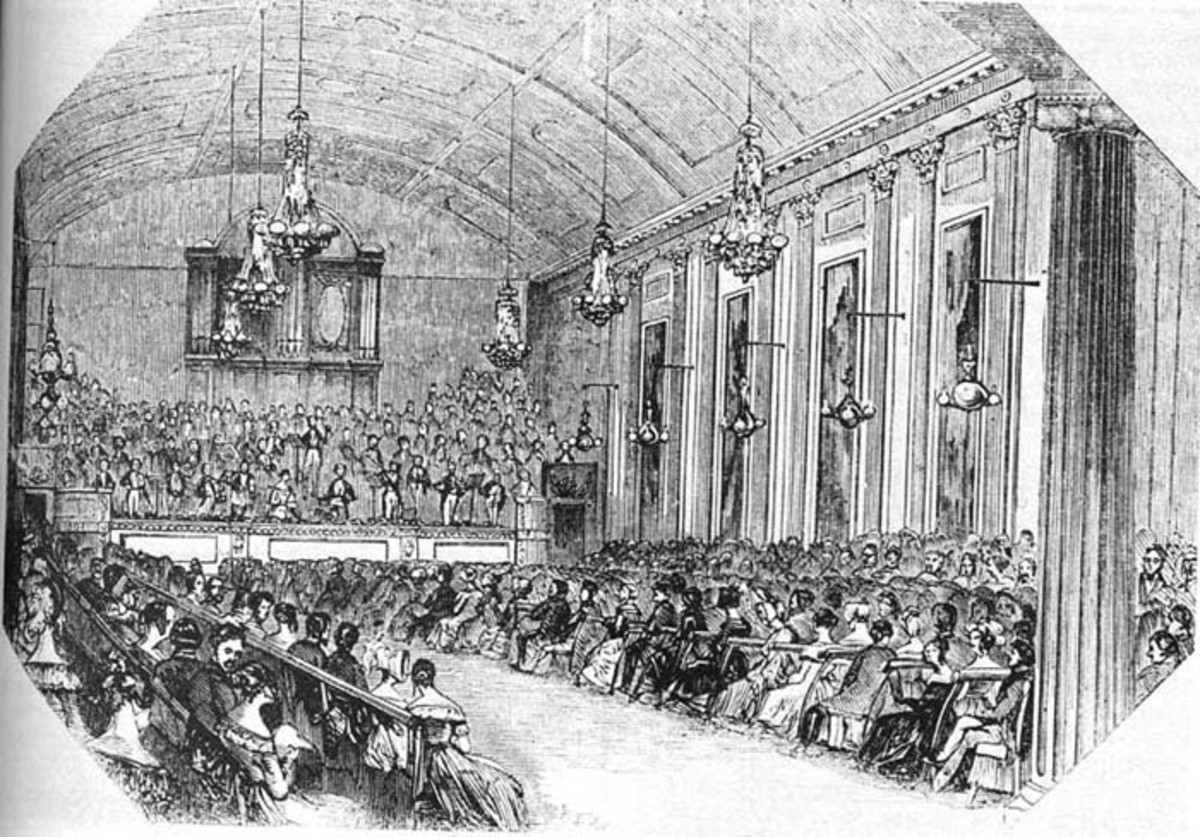
A London concert in 1843

The Land without Music

In 1904 the German music critic Oscar Schmitz levelled the charge that Great Britain was “the land without music”, and it was a charge with substance, at least as far as composition was concerned. Scarcely anything worthy of note had been produced by someone born in Britain since Henry Purcell, who died in 1695. There had of course been the towering figure of Georg Frideric Handel during the early 18th century, but he had been born in Halle (modern Germany) and was already a well-established and successful composer when he settled in London at the age of 27 in 1712.

There is also plenty of evidence that the British performed and enjoyed good music all through the “barren” period of the late 18th and early 19th centuries. However, they relied on overseas composers to bring the music to them. Notable examples are Mozart, Haydn and Mendelssohn.

Mozart’s visit was when he was still a child – although his first three symphonies were almost certainly composed in London – but Haydn made two highly successful visits and several of his best-known symphonies were composed wholly or in part when so doing.

Felix Mendelssohn made ten visits to England and/or Scotland between 1829 and 1847, and some of his best-known work (notably The Hebrides Overture and the Scottish Symphony) were inspired by his visits. His oratorio “Elijah” was commissioned by a Birmingham music festival and received its premiere in Birmingham Town Hall. His performances were always well received, not least by Queen Victoria.

However, that still left virtually nothing of worth having been written by home-grown composers.

Parry and Stanford


The Victorian musical renaissance was led mainly by Charles Hubert Parry (1848-1918) and Charles Villiers Stanford (1852-1924). Parry was more of a theorist and Stanford the more accomplished musician.

Parry was thoroughly English (born in Bournemouth) but Stanford was born in Dublin and only came to England when admitted to Cambridge University at the age of 18. Ireland was part of the United Kingdom during the 19th century, so he was always a UK subject.

Both composers adopted the idea of setting to music the poetry of great English writers and composing pieces that were well suited to performance by choirs and choruses, thus taking advantage of the English choral tradition that had long been fostered by well-established cathedral choirs and had found its way out of cathedrals into amateur and professional choral societies that regularly performed such works as Handel’s “Messiah” and Mendelssohn’s “Elijah”, mentioned above.

Parry made a great impression with his 1880 setting of Shelley’s “Prometheus Unbound”, and in 1886 Stanford set Tennyson’s “Revenge” to music. Parry wrote some highly successful oratorios, such as “Job” and “Judith”, and his choral odes “I Was Glad” and “Blest Pair of Sirens” are still performed regularly. He is probably best known as the composer of the tune of "Jerusalem" ("And Did Those Feet ...").

Stanford was also notable for composing the first full-length British symphonies, completing seven in total.

The Royal College of Music

Parry and Stanford were both leading lights in the Royal College of Music, which was founded in London in 1882 with the aim of providing a rigorous grounding in the basics of both composition and performance. One of its basic ideas was that budding composers would be able to try out their pieces by having them performed by well-trained and competent orchestral musicians.

Parry and Stanford both served as professors of composition at the RCM, with Parry being the college’s Director from 1894 up to his death in 1918. It is entirely possible that these two pioneers would have developed even further as composers had they not devoted so much energy to teaching.

Composers who benefitted from the tuition of Parry and Stanford at the RCM included Ralph Vaughan Williams, Gustav Holst, Samuel Coleridge-Taylor and John Ireland. These men would form the nucleus of the next generation of British composers who would build on the start that Parry, Stanford and others had given them.

It would be a mistake to give Parry and Stanford all the credit for the musical renaissance that took place in late Victorian Britain. The RCM was the brainchild of others, most notably Sir George Grove (the founding editor of “Grove’s Dictionary of Music and Musicians”). There was also another well-established musical institution in London, namely the Royal Academy of Music that opened its doors in 1822, but this had concentrated on performance rather than composition and did not have the emphasis on professional musicianship that the RCM was to engender.


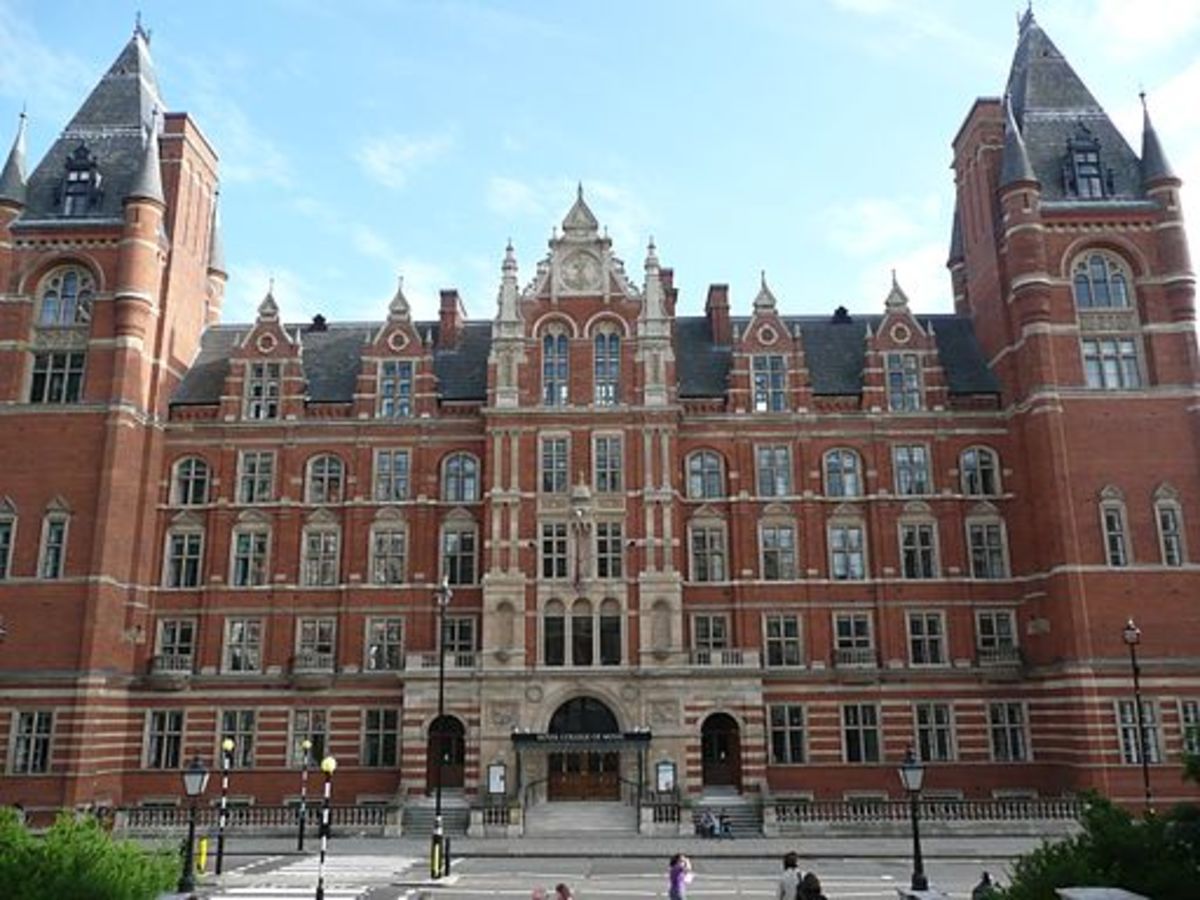
Royal College of Music, London

Sir Edward Elgar

To the general public, no composer better represents the revival of British music during this period than Sir Edward Elgar (1857-1934), famed for works such the “Pomp and Circumstance Marches”, “Enigma Variations”, “The Dream of Gerontius” and much-loved concertos for violin and cello.

There can be no doubt that Elgar was a far greater composer than either Parry or Stanford. However, Elgar was very much an “outsider” in terms of the work that those two composers were doing. His base was his home county of Worcestershire, but his musical education was from the continent of Europe and his skills as a composer were largely self-taught.

Elgar fused the Wagnerian and Brahmsian influences that were then coursing through European music with impressions gleaned from Liszt, Verdi and Strauss.

However, although universally beloved in England, Elgar’s music has never been as widely appreciated by audiences elsewhere. This may in part be because Elgar was every bit as enamoured of the English choral tradition as were Parry and Stanford. He made his name as a champion of the Three Choirs Festival, which showcased the cathedral choirs of Worcester, Gloucester and Hereford Cathedrals, writing anthems and oratorios intended for an ecclesiastical setting.

With the exception of “The Dream of Gerontius”, it is Elgar’s instrumental music that is more often heard today, and which is regarded by most hearers as being quintessentially British, which is ironic given the strong Germanic influences on the composer’s musical background.

A Firm Foundation

The three composers mentioned above lit the fuse for an outpouring of musical composition in Great Britain. Apart from the early products of the Royal College of Music referred to earlier, mention should also be made of Frederick Delius (1862-1934), Herbert Howells (1892-1983), Gerald Finzi (1901-56) and William Walton (1902-83). The accusation of Britain being a land without music could not possibly have been levelled at any time since it first ceased to be a gross inaccuracy.

© John Welford

Monday, 2 April 2018

François André Philidor: chess master and composer


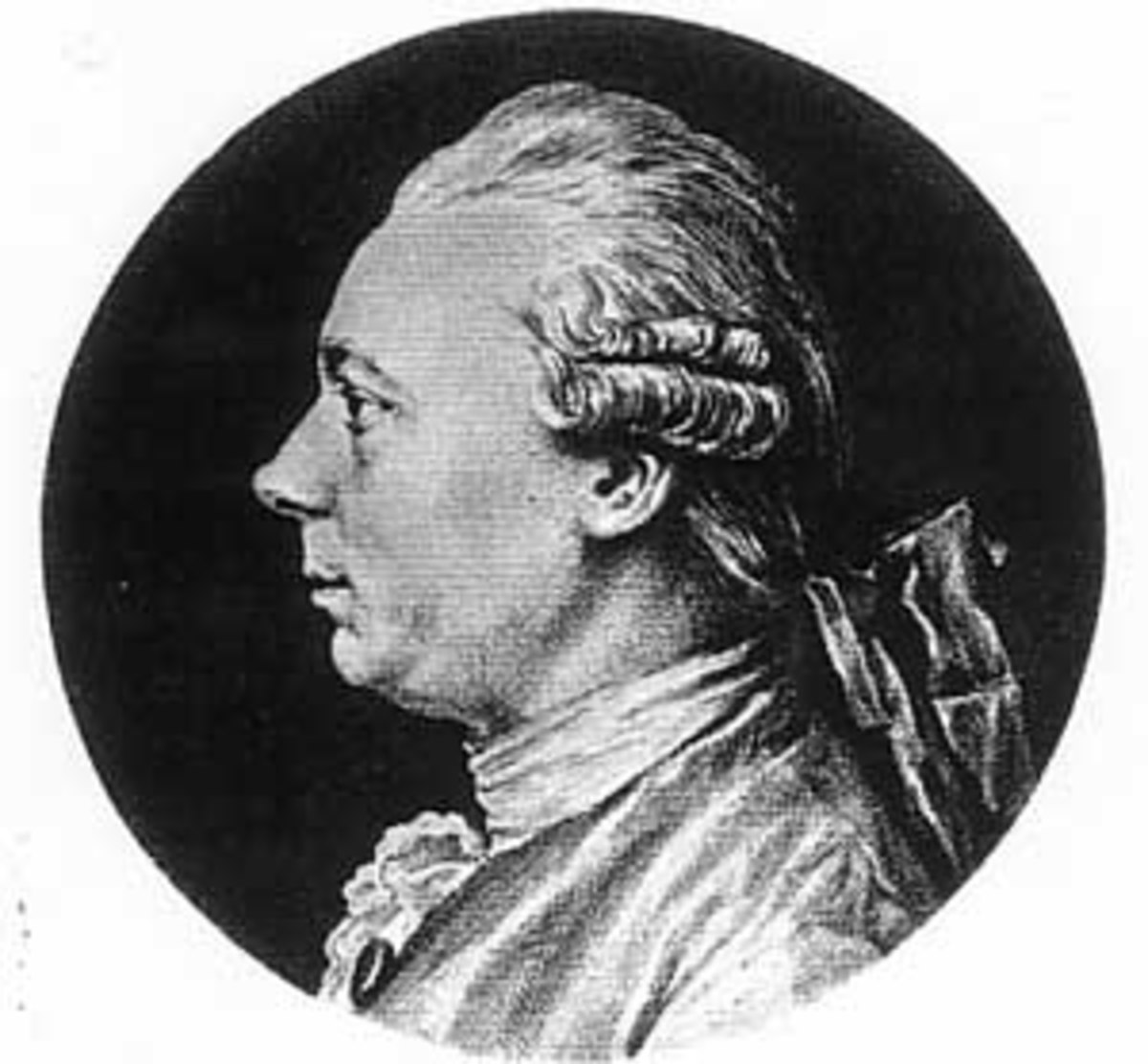
 François André Philidor


François André Philidor had an unusual claim to fame in that he was both a chess master and a musician and composer. He lived during the 18th century.

The Philidor family

There were three generations of musical Philidors, covering the period from around 1600 to 1800. They were largely instrumentalists at the courts of the French kings Louis XIV and XV, with their favourite instruments being the cromorne (a sort of oboe) and the tromba marina (a large single-stringed bowed instrument), although it is known that there were Philidor drummers, violinists and fife players.

As many as 14 Philidors have been identified by name, but it is probable that several others had musical talents.


François André Philidor
François André Philidor was the most renowned member of the family. He was born at Dreux (in the Eure-et-Loire region west of Paris) in 1726.  

He first came to public attention as a highly talented chess player, and toured as a virtuoso at the game before he was 20. As a young man he once played a game against the American ambassador to France, one Benjamin Franklin.
He often visited London, where the Chess Club eventually gave him a regular pension. He took on all sorts of challenges, including simultaneous matches against three opponents, Philidor being blindfolded.

His musical ability was not inconsiderable, and for a time he earned a living as a music teacher and copyist. When in London he heard the oratorios of Handel and began to compose similar works of his own.

He later turned to comic opera and produced a series of highly successful works in Paris. His place in the history of opera stems from his innovative use of dramatic ensembles. 
The French Revolution forced Philidor to flee Paris for London, which is where he died in 1795.

© John Welford

Saturday, 17 December 2016

The Festival of Nine Lessons and Carols


For many people in Great Britain and elsewhere, Christmas really begins at 3pm on Christmas Eve with the BBC’s live radio broadcast of the Festival of Nine Lessons and Carols from the magnificent chapel of King’s College, Cambridge.  For about an hour and a half, the chapel choir sings carols old and new, interspersed with Bible readings that tell the Christmas story.

The tradition dates back to 1918 when the College Dean, Rev Eric Milner-White, first modified an idea that originated in 1880 at Truro Cathedral. The format has been virtually unchanged since the 1919 service, when the order of lessons was established, as well as the custom of beginning with “Once in Royal David’s City” with the first verse sung by an unaccompanied boy treble.

The Festival was first broadcast by the BBC in 1928 and it has been heard every year since then, with only one exception (1930). Even during the war years, when the stained glass windows had been removed from the unheated chapel, listeners to the BBC and its World Service were able to hear the Festival.

Many great ideas are simple ones, and the “Nine Lessons” format is one such idea. It has therefore been copied in churches of all denominations throughout the Christian world, with many such services being held at Christmas time, the chosen carols being ones that suit particular choirs and congregations. It is an occasion on which a church or cathedral choir can show off its skills, and many choirmasters work long and hard to achieve perfection on the day, especially when introducing carols that may be new to the choir in question.

The nine lessons, at King’s College and elsewhere, are each read by different people, including lay people and clergy. It is traditional for the first lesson to be read by a young person, such as a treble from the choir, and for the ninth to be read by the priest or minister in charge, with the congregation standing.

Each lesson is introduced by a standard line (the first being “God announces in the Garden of Eden that the seed of woman shall bruise the serpent’s head”) and concluded with “Thanks be to God”.

Although the first three lessons and the last three are virtually sacrosanct, for the middle three there are alternative readings that can be given. For example, the Annunciation (from Luke’s Gospel) can be substituted by “Arise, shine, for thy light is come” from the Book of Isaiah. The readings are always from the 1611 Authorised (or “King James”) Bible.

The purpose of the lessons is not only to tell the familiar story of the Nativity from the Gospels of Matthew and Luke, but to set it in its full context, beginning with the Fall of Man in Genesis and including the prophecies of Isaiah that foretell the coming of the Messiah. The ninth lesson is always the opening of the Gospel of John that explains how “In the beginning was the Word” and “the Word was made flesh”.

As mentioned above, the service begins with “Once in Royal David’s City” that (at King’s College and elsewhere) is used as a processional hymn, begun in candlelight, as the voice of the boy treble breaks the silence. It is traditional at King’s for the boy chosen to sing the opening verse not to be told this until shortly before the service, so that he does not become unduly nervous.

The rest of the opening hymn is sung by the full choir and congregation, at the conclusion of which the Bidding Prayer is given, followed by the Lord’s Prayer, after which the first choir carol is sung.

It should be pointed out that “Nine” refers to the lessons and not the carols, of which somewhat more than nine can be expected. At King’s College it is usual for there to be one carol before the first lesson and two between each of the next lessons, with “O Come All Ye Faithful” following the ninth lesson and “Hark the Herald Angels Sing” concluding the service after the final Collect and Blessing. At least two of the carols will in fact be hymns for the full congregation to sing, as well as the two final hymns mentioned above.

The carols are usually a good mixture of traditional ones and those that are less familiar, and it has been customary at King’s College to include a completely new carol that has been specially commissioned.  These brand new carols are often challenging for both the choir and listeners, and it has to be said that many are heard once during the service and almost never again!

The Director of Music at King’s College from 1982 to 2018 was Stephen Cleobury, who arranged a number of traditional carols for performance at the Festival. Other arrangements have been by David Willcocks, who held the Director of Music post from 1957 to 1974. These two master musicians have ensured that the music heard at the Festival is ideally suited to both the choir and the remarkable acoustics of the Chapel.

The Christmas Eve Festival at King’s College is extremely popular with the local population in Cambridge, and people have been known to camp overnight in hope of getting one of the 650 seats in the Chapel, which are always allocated on the basis of first come, first served.

As well as the Christmas Eve broadcast, which is recorded and repeated on Christmas Day and on other networks, including in the United States, a televised programme called “Carols from King’s” is recorded earlier in December and broadcast on BBC 2, but this is not the full “Nine Lessons and Carols”.

The tradition of presenting the Christmas story in this format has now become deeply entrenched among choirs and churches all over the world, and looks set to continue for many years into the future.

© John Welford 

Thursday, 27 October 2016

Some classic Christmas carols


It is essential to define what is meant by a Christmas carol, because the term has been misused so often that virtually any piece of sung music associated with Christmas could be called a carol.

A carol must be religious in content, and celebratory. It is also usually joyful in tone, although this is not always the case (e.g. the Coventry Carol below). It has become common practice for any hymn sung at Christmas time to be called a carol, but that is not particularly appropriate, as a hymn is defined as being suitable for singing by a congregation in church, and that is certainly not true of all carols.

If we take the term “carol” to exclude all non-religious Christmas songs, as well as all hymns that are designed primarily for congregational singing, there are still many “classic” carols that choirs will sing at Christmas, as will carol-singers going from door to door. Here are a few examples:

The Coventry Carol

This dates from the 15th century and was part of the Coventry cycle of mystery plays . A series of short plays on Biblical themes, each presented by a merchant’s guild or other local group, would be performed in sequence to the townspeople, possibly staged on wagons that would be drawn from place to place so that the audience would see each play as it came along and the actors would give as many performances as there were places where the audiences had gathered.

Only two Coventry plays have survived, one being the Nativity play of the Shearmen and Tailors, of which the carol was part. It concerns the “Massacre of the Innocents” by the soldiers of King Herod after the birth of Jesus. The carol is sung by the women of Bethlehem in the play, just before the soldiers enter. It is partly a lullaby, with the refrain “Lully lulla, thou little tiny child, by by lully lullay” and partly a lament for the children who are about to die: “That woe is me, Poor child for thee!” It can therefore be seen as foreseeing the death of Christ as well as celebrating his birth and commenting on the immediate event of the massacre.

The tune normally sung to the carol is based on one that dates back to 1591.

We Wish You a Merry Christmas

This is the carol most often performed on British doorsteps! It is a traditional carol from the West of England, and it breaks the rule about carols being religious, because it quite plainly is not. Most modern carol singers get as far as “Good tidings we bring , to you and your kin, We wish you a Merry Christmas and a Happy New Year” and then bash on the door to demand money. However, the full version is an extended threat, with “figgy pudding” being very much on the carollers’ minds.

Having sung “Now bring us some figgy pudding, And bring some out here” in the second verse, and explaining that “We all like figgy pudding” in the third, the singers make their demand explicit in the final verse with the rousing chorus of “We won’t go till we’ve got some, So bring some out here!”

The Sussex Carol

This carol appears to go back to at least the 17th century, but is known today thanks to the efforts of Cecil Sharp and Ralph Vaughan Williams, who were both interested in collecting English folk songs that they heard sung by rural villagers in the late 19th and early 20th centuries. Cecil Sharp collected this carol from Gloucestershire, but Vaughan Williams heard it sung in a village near Horsham in Sussex, which is why it has the title of the Sussex Carol. Vaughan Williams included it in his “Fantasia on Christmas Carols” which was first performed at the Three Choirs Festival in 1912, and it was later arranged by David Willcocks for the annual Festival of Nine Lessons and Carols at King’s College, Cambridge, where it is regularly performed to this day.

It is a bright, lively carol that has a simple tune and easily memorised words, beginning: “On Christmas night all Christians sing, To hear the news the angels bring, News of great joy, news of great mirth, News of our merciful King’s birth.” Whatever arrangement is sung, the four short verses, ending with “Glory to God and peace to men, Now and for evermore. Amen” do not take long to sing, but it makes an excellent impression when sung well, and certainly counts as a classic English carol.

The Three Kings

This 19th century carol has become a “standard” with choirs that boast a decent tenor or baritone soloist. It was composed by Peter Cornelius (1824-74), a German composer of lieder and operas who was a friend of Wagner and Liszt. However, the carol in question is his only piece that is heard regularly today, in translation and usually in the arrangement by Ivor Atkins.

The most unusual feature of the carol, which, not surprisingly, tells the story of the visit of the Magi to the birthplace of Jesus at Bethlehem, is the fact that you get two carols for the price of one. The soloist sings two verses to the same tune, giving the basic story, followed by an extended conclusion, to a different tune and with varied rhythm, that exhorts the hearer to also travel with the Kings and “offer thy heart”.

However, at the same time that the soloist is singing the above, a four-part choir sings a stately chorale to a different tune and with different words. Their carol begins “How brightly shines the morning star, With grace and truth from heaven afar” and ends with “Inly feeds us, rightly leads us, life bestowing. Praise, o praise such love o’erflowing”. It therefore complements the words being sung by the soloist as well as dovetailing perfectly with the music as a piece of counterpoint to a different rhythm.

As described, it may sound as though it would be difficult for an average church choir to perform, but that is not the case. As long as everyone keeps the beat perfectly, and the dynamics of the choir do not overpower the soloist, who should stand at some distance from the choir, it should work very well. When sung as intended, The Three Kings is extremely effective.

Ding Dong Merrily on High

This carol ticks all the boxes as a classic carol, and is part of the Christmas repertoire of just about every church choir.

The words are by George Ratcliffe Woodward (1848-1934), an Anglican priest who had a passion for bell-ringing as well as poetry.  He had a very good ear for music and sometimes produced tunes for his own words, but more often left this to his younger friend, the Irish composer Charles Wood (1866-1926). They collaborated on a number of carols, for all seasons, and produced three books of them. Wood often adapted traditional tunes for use as carols, and the tune of “Ding Dong Merrily” is one such, having been a 16th century French tune.

It is a carol all about bells, comprising three short verses and a “peal” of a chorus to the words “Gloria, Hosanna in excelsis” with the different voices tumbling over each other just as church bells would do. The chorus is repeated, being sung once fortissimo and once piano; the dynamics are reversed for the final chorus so that the carol ends on a blast of sound.

There is no Christmas carol that is brighter or more joyful, making “Ding Dong Merrily” about as classic as you can get!


© John Welford

Monday, 3 October 2016

The British National Anthem


The British national anthem was the first in the world to be adopted as such, with every other country in the world subsequently following suit, sometimes even using the same tune. Like many British institutions it was a matter of evolution rather than deliberate creation, coming about almost by accident.
  
The historical background

It was first heard in anything like its current form in September 1745 at Drury Lane Theatre in London, where it was enthusiastically received and encored several times. Its use then spread to other theatres and was soon used on occasions when the King was present or some expression of patriotism was called for.

These were troublesome times. The British monarchy, under King George II, was threatened by an uprising led by “Bonnie Prince Charlie”, the grandson of King James II who had been deposed in 1688. Although King George was not universally popular and was himself a foreigner in the eyes of most of his British subjects, the prospect of a revolution led by a Catholic prince was even less welcome, and the English (as opposed to the Scottish) people were keen to rally behind their Hanoverian king.

At the time of the first performance of “God Save the King”, Charles Edward Stuart’s army of Highlanders had reached Edinburgh and was gathering support as it prepared to venture south into England. It was to advance as far as Derby, in the English Midlands, by early December, but then turned back when the “Young Pretender’s” supporters got cold feet.

The patriotic song was therefore written at a time of great national distress, with its words focussed on the person of the King who stood in opposition to the threat from the North. The author of the words is unknown, as is the composer of the tune, although it is possible that Dr Thomas Arne arranged it for its original performance. Neither the words nor the music were completely original, and there is evidence that versions of both were in use long before 1745. One ironic possibility, given its use in 1745, is that the tune was based on an old Scottish carol.

The text


The original first verse was as follows:

God save our noble King!
God save Great George our King!
God save the King!
Send him victorious,
Happy and glorious,
Long to reign over us,
God save the King.


(The first two lines have since been changed to meet later circumstances, to:

           
God save our gracious King/Queen
            Long live our noble King/Queen)


Some of the words, including “God save the King” and “long to reign over us” can be traced back to common use in the 16th century, and versions of the song had also been sung in praise of previous monarchs, including James II. The 1745 version, however, had a specific aim in mind, which was to offer a prayer for the safety of the King, and hence the nation, from a very present threat.

An ironic anthem

It is somewhat ironic that this should have become the national anthem of the whole of Great Britain, which it did from the early 1800s as a matter of general acceptance rather than as the result of any decree or law. The irony lies in the fact that it was written to support one side of what was, in effect, a civil war. Indeed, as new verses were written to supplement the original one, some were so partisan and specific as to be completely unacceptable within a British anthem. For example:


Lord, grant that Marshal Wade,
May by thy mighty aid,
Victory bring.
May he sedition hush,
and like a torrent rush,
Rebellious Scots to crush,
God save the King.


Needless to say, this verse is not used today, even in the fullest version of the anthem, and it was never part of the “official” version. Even so, the anthem is much less popular in the non-English parts of Great Britain, with the Welsh and Scots being content to express their Welshness and Scottishness with their own anthems.

The saving grace of “God Save the Queen” (which it has been since 1952 and was also during the reign of Queen Victoria) as a national anthem for the whole country is that it is a prayer for the safety of the monarch and makes no mention of the country in any of the verses. It can therefore be sung in any part of the country that recognises the Queen as monarch, and that is something that also applies to countries of the British Commonwealth that are independent but still regard the Queen as their figurative head of government.

Some strange features of the National Anthem

As mentioned above, Wales and Scotland have their own anthems, which are used at such events as sporting events between the individual countries of Great Britain, but England as such does not have one, leading to the somewhat bizarre consequence of England teams having to use the national anthem for the whole country when playing other parts of the same country!

It is usual for only one verse of God Save the Queen to be played, but when an extended version is required the third “official” verse is commonly preferred to the second, which includes the lines:


Scatter her enemies
And make them fall.
Confound their politics
Frustrate their knavish tricks


The preferred third verse is much more politically correct:


Thy choicest gifts in store
On her be pleased to pour
Long may she reign.
May she defend our laws
And ever give us cause
To sing with heart and voice,
God Save the Queen.


 The British national anthem is unusual in being neither a paean of praise about the country in question nor, in its current version, a reference to military power, with the sole exception of the line “Send her victorious”. It could be said that it is only a national anthem because the monarch is the titular head of the nation; should the country ever become a republic the national anthem would clearly have to be changed.

It is also of interest that the tune used for God Save the Queen is by no means limited to the United Kingdom. Americans will recognise it as “My Country Tis of Thee” and it is still used for the national anthem of Liechtenstein (Switzerland also used the tune until 1961). On the rare occasions when an English football team plays Liechtenstein, the same tune is played twice!

Another odd feature of this national anthem is that the head of state never sings it. On occasions when the Queen is present everyone will stand to attention (no heart-crossing here!) and sing the anthem, including other members of the royal family, but the Queen herself stays tight-lipped and silent. Given the lyrics, how could she do otherwise?

Whether the citizens of Great Britain and Northern Ireland like it or not, they are probably stuck with God Save the Queen for the foreseeable future, the only likely change being the switch back to “King” when the next monarch takes over.


© John Welford